Image: linked YouTube thumbnail.
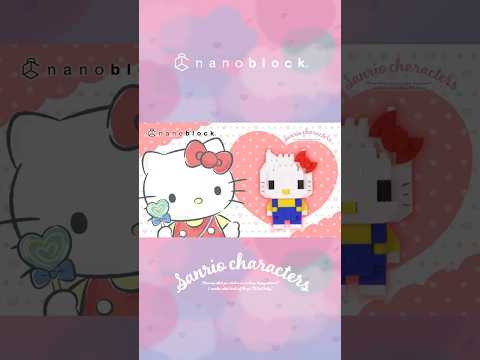
Sanrio Nanoblock is not one set. The name covers multiple generations of Hello Kitty and Friends models, including individually boxed Character Collection kits, themed costume versions and blind-packaged Mininano figures. For most U.S. buyers who want a specific character, the safest starting point is the six-model group numbered NBCC_177 through NBCC_182. You know which character you are getting, and Kawada provides individual specifications and downloadable instructions for every model.
The most important shopping rule is simple: compare the model number, not just the character name. A listing titled “My Melody Nanoblock,” for example, could describe an older 90-piece figure, the 170-piece NBCC_178 model or a newer costume design. The name alone does not establish the piece count, size or instructions.
In this guide:
- Which set should you choose?
- The six core models compared
- Standard kits, Mininano and themed versions
- What to check before buying
- Official Sanrio Nanoblock instructions
- How to prepare for the build
- Common build problems
- A documented Kuromi build
- Handling and displaying the models
- Where to buy and how to check authenticity
- Frequently asked questions
Which set should you choose?
If you want one recognizable character without dealing with a blind package, choose from NBCC_177 through NBCC_182. They belong to the same coordinated release, share similar packaging dimensions and form a visually consistent shelf group. Your preferred character should usually decide the purchase, but the shapes have practical differences.
- Choose Hello Kitty NBCC_177 for a compact first model. Its 140 pieces form a relatively narrow figure. The bow adds an identifiable detail without making the footprint especially wide.
- Choose My Melody NBCC_178 if height and the drooping-ear silhouette matter most. At 170 pieces, it has the largest official piece count in this six-model group. The tall hood and ear produce a different display profile from the rounder figures.
- Choose Kuromi NBCC_179 for the most head detail. The printed skull, hood collar, angled ears and tail give the model a more elaborate outline. Those details also create more orientation checks than a simple rounded figure.
- Choose Cinnamoroll NBCC_180 if you want the widest silhouette. The finished model is officially listed at 80 mm wide, largely because of the ears. One documented builder found the completed model prone to tipping, so it suits a stable shelf better than a frequently bumped desk.
- Choose Pochacco NBCC_181 for a taller, narrow character. Its long ears bring the official height to 68 mm even though the set contains 130 pieces, tying Cinnamoroll for the lowest count in this group.
- Choose Pompompurin NBCC_182 for a compact, rounded display model. Its 140-piece count matches Hello Kitty’s, while the beret and printed rear marking distinguish the finished figure.
These recommendations are based on official specifications, manufacturer instructions and attributed third-party builds. They are not presented as firsthand testing by this website.
The six core models compared
The table below uses Kawada’s official Japanese catalog specifications. Inch figures are rounded conversions of the listed millimeter dimensions, not measurements taken by this website.
| Character | Model | Pieces | Finished size, W × H × D | Practical implication |
|---|---|---|---|---|
| Hello Kitty | NBCC_177 | 140 | 39 × 53 × 29 mm (about 1.5 × 2.1 × 1.1 in) |
A compact footprint with a projecting bow and tail. |
| My Melody | NBCC_178 | 170 | 40 × 65 × 29 mm (about 1.6 × 2.6 × 1.1 in) |
The highest piece count of the six and a relatively tall profile. |
| Kuromi | NBCC_179 | 160 | 55 × 64 × 29 mm (about 2.2 × 2.5 × 1.1 in) |
Angled ears, hood details and a wider head require careful orientation. |
| Cinnamoroll | NBCC_180 | 130 | 80 × 41 × 25 mm (about 3.1 × 1.6 × 1.0 in) |
The widest model by a clear margin; allow extra side-to-side shelf space. |
| Pochacco | NBCC_181 | 130 | 52 × 68 × 30 mm (about 2.0 × 2.7 × 1.2 in) |
The tallest official height in the group despite the joint-lowest piece count. |
| Pompompurin | NBCC_182 | 140 | 44 × 53 × 29 mm (about 1.7 × 2.1 × 1.1 in) |
A compact body with few long projections beyond the beret and ears. |
Piece count is not a reliable difficulty shortcut here. A 130-piece model can still be awkward if its wide ears affect balance, while a higher count may simply create a taller or more layered shape. The size and placement of the parts matter as much as the total.
Standard kits, Mininano and themed versions
Several products can appear under the same broad “Sanrio Nanoblock” label. Separating them by product line prevents most specification and instruction mistakes.
Character Collection kits
NBCC_177 through NBCC_182 are named-character kits. Each model has its own product number, parts inventory and instruction sheet. They are not blind boxes: the box identifies the character inside.
Older Character Collection designs also remain visible in U.S. search results. One U.S. My Melody listing, for example, describes a 90-piece Level 1 model, while the newer NBCC_178 contains 170 pieces. Both can legitimately be called “My Melody Nanoblock,” but they are not interchangeable versions and must not share instructions.
Mininano blind packages
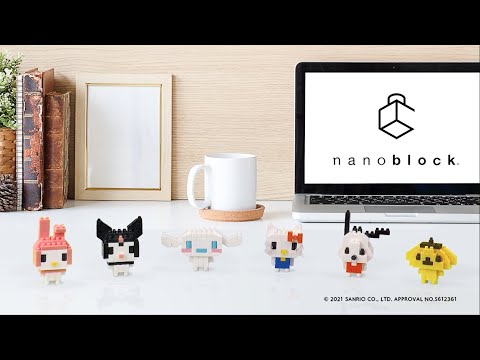
Image: linked YouTube thumbnail.
Mininano uses smaller collectible designs sold in blind packaging. The original NBMC_04 Sanrio assortment contains Hello Kitty, My Melody, Kuromi, Pompompurin, Cinnamoroll and Pochacco. Kawada lists the Hello Kitty example at 70 pieces and 36 × 38 × 12 mm, substantially smaller than NBCC_177.
Buying one NBMC_04 package does not let you select the character. Kawada states that the six-package box contains the complete six-character lineup, but buyers should still verify that a retailer is selling a sealed full box rather than six individually selected packages.
Other Mininano assortments have different rosters. NBMC_47 focuses on the Hapidanbui group, while the 2026 NBMC_93 Funyumaru assortment returns to characters including Hello Kitty, My Melody, Kuromi, Cinnamoroll, Pompompurin and Hangyodon. A Mininano manual from one assortment should never be applied to a similarly named figure from another.
Themed costume releases
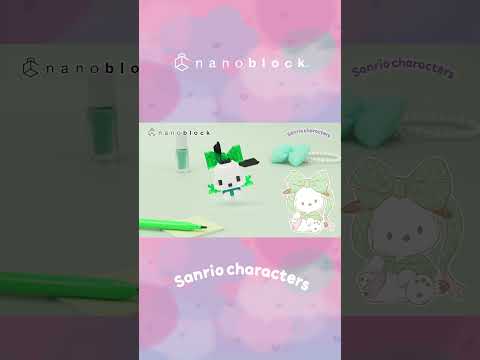
Image: linked YouTube thumbnail.
Kawada’s catalog also includes costume and pose variations, including kimono, ninja, dress-up, Big Ribbon and Dreaming Angel models. These are separate kits with their own NBCC numbers. U.S. availability may lag behind the Japanese catalog, so treat a Japanese release date as a catalog fact rather than a promise of U.S. stock.
What to check before buying

Image: linked YouTube thumbnail from the independent creator’s video.
A small amount of label checking is more useful than comparing listing titles. Before ordering, look for the following:
- Find the exact model number. It should appear on the package or in a clear product description. If a listing only says “Kuromi Nanoblock,” ask the seller which version it is.
- Match the piece count to that model. For the six core models, compare the listing with the official table above. A different count may indicate an older or themed version rather than an error.
- Determine whether it is blind packaged. NBMC Mininano products conceal the character in an individual package. The NBCC models compared above identify the character.
- Read the age marking on the actual regional package. Kawada lists these Japanese products for ages 12 and older, while authorized U.S. listings for some models state ages 8 and older. Follow the package supplied in your market, especially when buying for a child.
- Inspect the seller and regional labeling. Manufacturer and distributor information is more useful than a generic claim that a product is “official.” Keep the receipt and packaging until the build is complete in case parts support is needed.
Official Sanrio Nanoblock instructions
This guide is a practical companion to the manufacturer’s official instructions. It does not replace the official diagrams. Use the manual that matches the model number printed on your package.
- Hello Kitty NBCC_177 official instructions
- My Melody NBCC_178 official instructions
- Kuromi NBCC_179 official instructions
- Cinnamoroll NBCC_180 official instructions
- Pochacco NBCC_181 official instructions
- Pompompurin NBCC_182 official instructions
Each linked manual is a one-page illustrated sheet with a parts inventory across the top. Existing construction appears in a faded color; the normally colored pieces are the additions for that stage. The diagrams also call out occasions when the body must be turned over or returned upright.
Pay special attention to the small symbols that distinguish pieces with different angles. Two white or pink pieces can look identical from above while their connection direction differs. If the next layer refuses to align, an angled piece from an earlier stage is a likely cause.
How to prepare for the build
These models are small enough to fit in a hand, but the workspace should be larger than the finished figure suggests. A shallow tray or mat keeps loose pieces from traveling, while bright directional light makes white-on-white and pink-on-pink edges easier to distinguish.
A practical preparation sequence is:
- Confirm the manual number against the box before opening the bags.
- Empty the pieces into a rimmed tray rather than directly onto a table.
- Separate broad color groups, then divide each color by length, width and angle.
- Place printed facial pieces, clear supports and unusual curved or angled parts in their own compartments.
- Keep the parts inventory visible, but do not assume every leftover piece is required; the official sheets state that extra blocks are included.
Nanoblock tweezers can help with small parts, particularly when removing an incorrectly placed piece from a recessed area. They are optional. A builder with steady fingertip control may not need them, but fingernails are a poor substitute for separating tightly connected layers because uneven leverage can disturb neighboring pieces.
Why the opening layer feels harder
The first layer has no completed structure supporting it. Several pieces may need to remain aligned relative to one another before the next layer locks them together. This is why a Level 2 model can feel unexpectedly fiddly during the first few minutes and much easier once the head or body becomes rigid.
Build that opening layer on a flat surface and count exposed studs from a known edge. Do not lift it repeatedly to compare it with the sheet. After adding the locking layer, check the outline again before continuing; an early one-stud offset can remain hidden until a later row no longer fits.
Read the whole panel first
Some panels show several placements feeding into one result. Before pressing anything down, identify every new part, the model’s orientation and the studs that should remain exposed. A quick look at the following panel can also clarify the intended result without changing the manufacturer’s sequence.
Common build problems
| Problem | Likely explanation | What to do |
|---|---|---|
| The first layer keeps moving | The loose pieces have not yet been locked by an overlapping layer. | Assemble it on the table, align the outside edges and hold the pieces gently while placing the next layer. Avoid squeezing before the studs are aligned. |
| A later row will not fit | An earlier piece may be offset by one stud or turned in the wrong direction. | Stop applying pressure. Compare the exposed-stud pattern with the previous diagram and work backward to the first mismatch. |
| Two similar pieces appear interchangeable | The set may contain left- and right-facing or differently angled parts. | Check the small angle symbols in the inventory and diagram. View the part from the side rather than only from above. |
| Kuromi’s ears do not match | The ear subassemblies use orientation-sensitive slopes. | Complete one ear exactly as shown, then treat it as a mirrored reference. Do not build two identical copies unless the official panel shows identical orientation. |
| Cinnamoroll tips over | The long ears create a wide upper profile, and the small body provides a limited support area. | Recheck the clear support shown in the official manual, press the body connections evenly and display the model on a level, low-traffic surface. |
| Several pieces remain after completion | Kawada’s instruction sheets state that extra blocks are included. | Compare the finished model with the final diagram. If every required feature is present and aligned, store the extras in a labeled bag with the model number. |
| A required piece appears to be missing | It may be in a bag corner, under another color group or already used incorrectly in an earlier layer. | Check the packaging seams, tray and completed layers against the inventory. For a U.S. purchase, contact the retailer or regional distributor identified on the package rather than Kawada’s Japan-only domestic support form. |
| A bow, ear or tail loosens during handling | Pressure is being transferred through a projecting detail instead of the main body. | Support the figure underneath its torso or head when moving it. Re-seat the loose connection at its base rather than pressing on the outer tip. |
Avoid glue during the initial build. Adhesive can preserve an unnoticed alignment error, mark the plastic and make later correction difficult. If a display model repeatedly separates after its construction has been independently verified, any permanent modification should be treated as a last resort and disclosed if the set may later be sold.
A documented Kuromi build
Amy’s Animals recorded the complete process of opening, sorting and assembling the 160-piece Kuromi model. The creator opens five packets, sorts the pieces and explains that the unsupported beginning was the hardest portion. She also identifies the manual’s faded parts as completed construction and the stronger colors as the pieces being added.
Video credit: Amy’s Animals. The video belongs to its creator and is embedded here as a third-party build reference.
The creator reports taking about an hour. That is one documented experience, not an average or a promised completion time. The video includes editing, and build speed depends on sorting, eyesight, dexterity and familiarity with layer-based Nanoblock diagrams. Its more useful lesson is that the build became easier after the opening layers created a stable structure.
Handling and displaying the models
These figures require little shelf area, but their widest or tallest details extend beyond their bodies. Cinnamoroll needs roughly twice the width of Hello Kitty, while Pochacco and My Melody require more vertical clearance. Leave room between models so one figure cannot knock another over.
Move a finished model by supporting its main mass, not by lifting an ear, bow, tail or hat. A clear display box can reduce dust and accidental contact, but measure the inside dimensions against the official finished size rather than relying on a seller’s broad “mini figure” description.
Keep the manual, spare pieces and packaging identification together. A small resealable bag labeled with the model number is sufficient. This matters once several Sanrio sets share the same white, black, pink or purple pieces.
Where to buy and how to check authenticity
U.S. shoppers may encounter Sanrio’s store, large retailers, specialist collectible stores and marketplace sellers. Availability and prices change too quickly for a fixed “best store” recommendation, so compare the exact model, seller, condition and return policy rather than the headline price alone.
For U.S.-distributed products, manufacturer copy used on major retail listings says that a Bandai Namco warning label identifies officially licensed Kawada products distributed for the U.S. market and provides access to U.S. product support. That is useful for U.S. stock, but a legitimate Japanese import can carry different regional labeling. Absence of a U.S. label does not by itself prove that an import is counterfeit.
A stronger check combines several details:
- The Kawada or Nanoblock branding is clearly printed rather than added only to the online listing.
- The model number corresponds to an official Kawada catalog entry or known regional version.
- The package carries appropriate Sanrio copyright or approval information.
- The pictured model, piece count and instructions all describe the same version.
- The seller identifies who fulfills the order and provides a usable return or missing-parts process.
Marketplace photos that omit every side of the box make verification harder. If the listing mixes photographs of two designs or combines an older piece count with a newer model number, request clarification before ordering.
Frequently asked questions
Are Sanrio Nanoblock sets official licensed products?
Kawada publishes officially licensed Sanrio models in its Nanoblock catalog, with Sanrio copyright or approval information shown on the product pages and packaging. Because unofficial micro-block products can use similar search terms, verify the manufacturer and exact model number rather than relying on the words “nano blocks.”
Are all Sanrio Nanoblock products blind boxes?
No. Mininano assortments such as NBMC_04 are blind packaged, but the NBCC Character Collection kits identify the character on the box. Check the product-line prefix and listing description before buying.
Why do some listings say ages 8+ while Kawada says 12+?
The labeling can differ by market. Kawada’s Japanese catalog lists the six core NBCC models for ages 12 and older, while authorized U.S. descriptions for some Sanrio models state ages 8 and older. Follow the safety and age information printed on the product actually supplied in your region.
NanoblockUS.com is an independent fan and informational resource dedicated to Nanoblock builders in the United States and beyond. We are not affiliated with Kawada Co., Ltd., the manufacturer of Nanoblock.. Our team is made up of hobbyists, collectors, and detail-obsessed builders who want to help you get the most out of these remarkable micro building sets.