
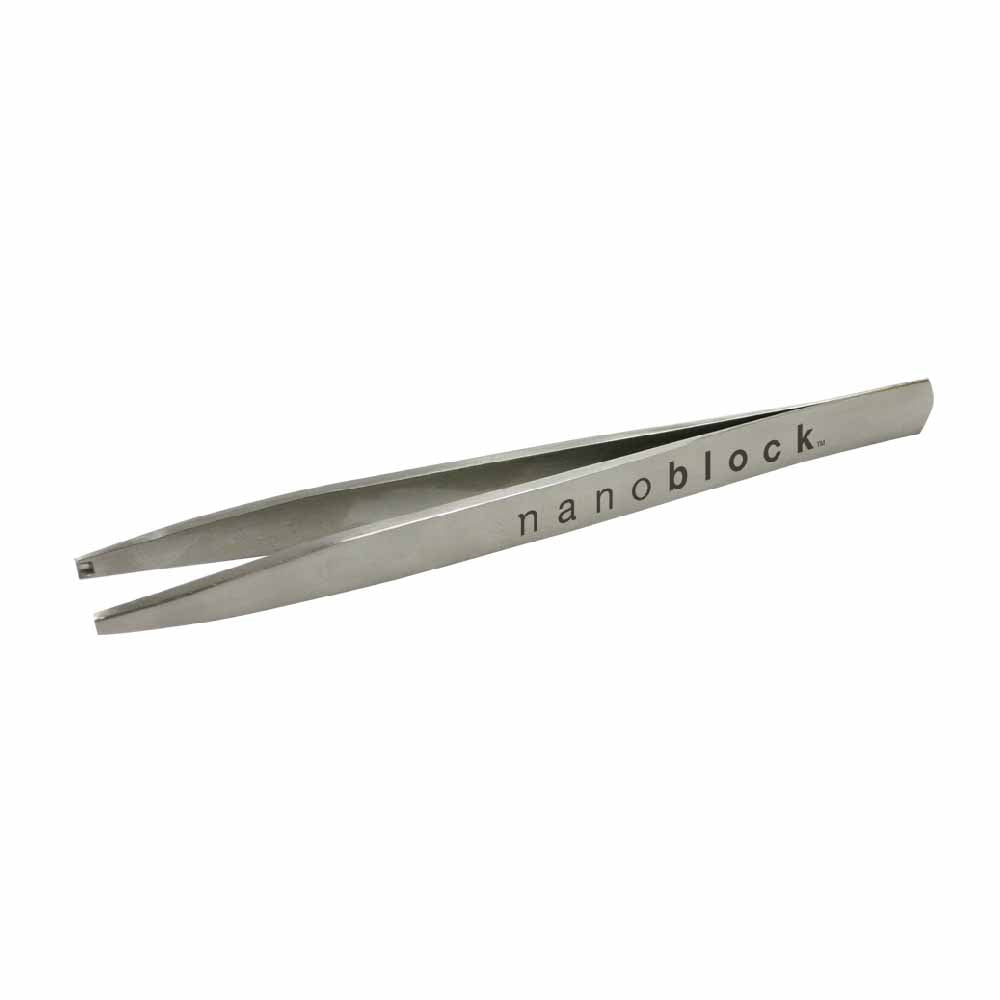
Kawada makes two different nanoblock tweezers, and the difference sits entirely in the tip. The NB-019 nanoblock Tweezers have a notch cut into the jaws so they seat over a brick’s stud instead of sliding off it, which is what makes them useful for pulling misplaced bricks back out. The second pair, sold in Japan and Europe as the Simple Tip Tweezers and at US retail as “Tweezers simplified ver.,” has flat jaws that suit smooth tiles and flat plates. Neither is required. Some builders in the r/nanoblock threads have finished dozens of sets, including thousand-piece models, using only their fingers. If you buy one pair, the notched NB-019 is the one that does something a generic tweezer can’t.
In this guide:
- Two official models, and why the names confuse people
- What Kawada actually publishes
- Do you need tweezers at all?
- How builders actually use them
- Matching the problem to the tool
- Cheap alternatives, and when they’re enough
- Why the pad may matter more than the tweezers
- Finding a pair in the United States
- What the official pages don’t explain
- Questions builders keep asking
Two official models, and why the names confuse people
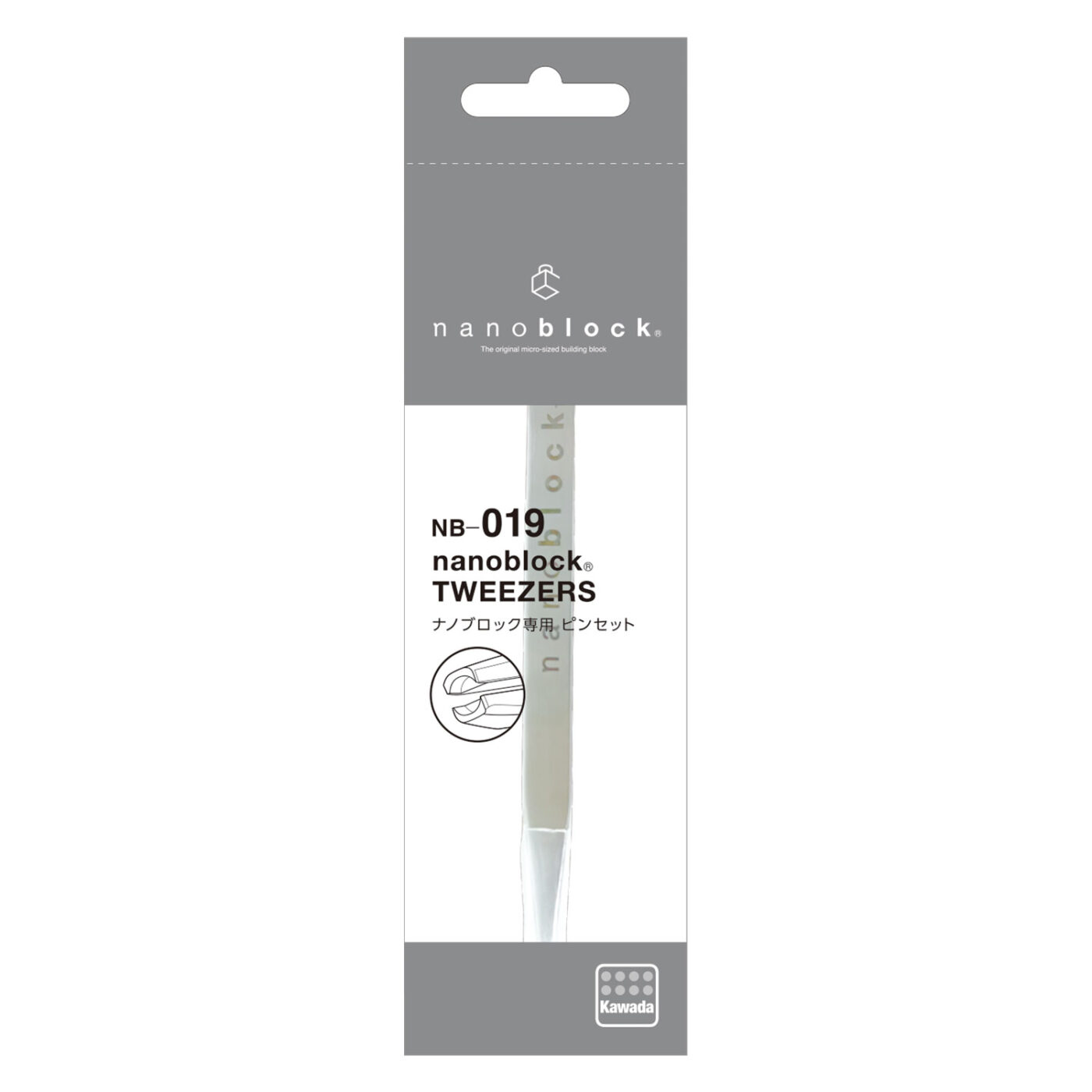
Most of the confusion around this accessory comes from the fact that two products share almost the same name. Kawada’s Australian store lists “nanoblock Tweezers” and “nanoblock Simple Tip Tweezers” as two separate items in the same accessory range, and US listings add a third label by calling the simple-tip pair the “simplified version.” A builder who sees “NB-019 nanoblock tweezers” printed in a manual, then finds only the simplified pair on a retail site, has no easy way to tell whether they’re looking at the same thing.
They aren’t. The clearest description of the difference comes from a builder in an r/nanoblock thread about fused bricks, who identified NB-019 as having a stud-shaped hole and NB-052 as being flat, calling the flat pair a useful addition for studless tiles. That matches Kawada’s own product copy, which describes the NB-019 tip as shaped to grip nanoblock studs firmly.
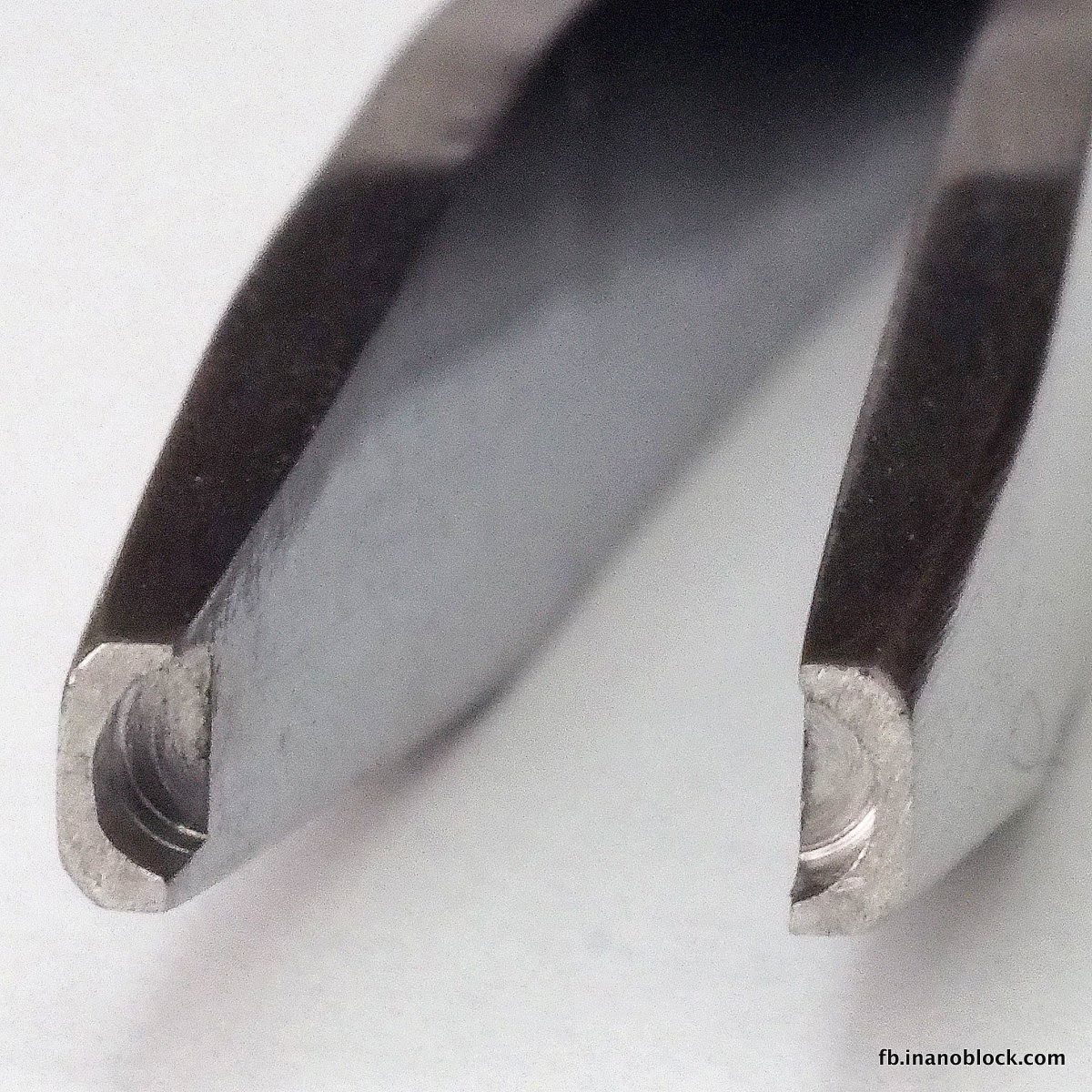
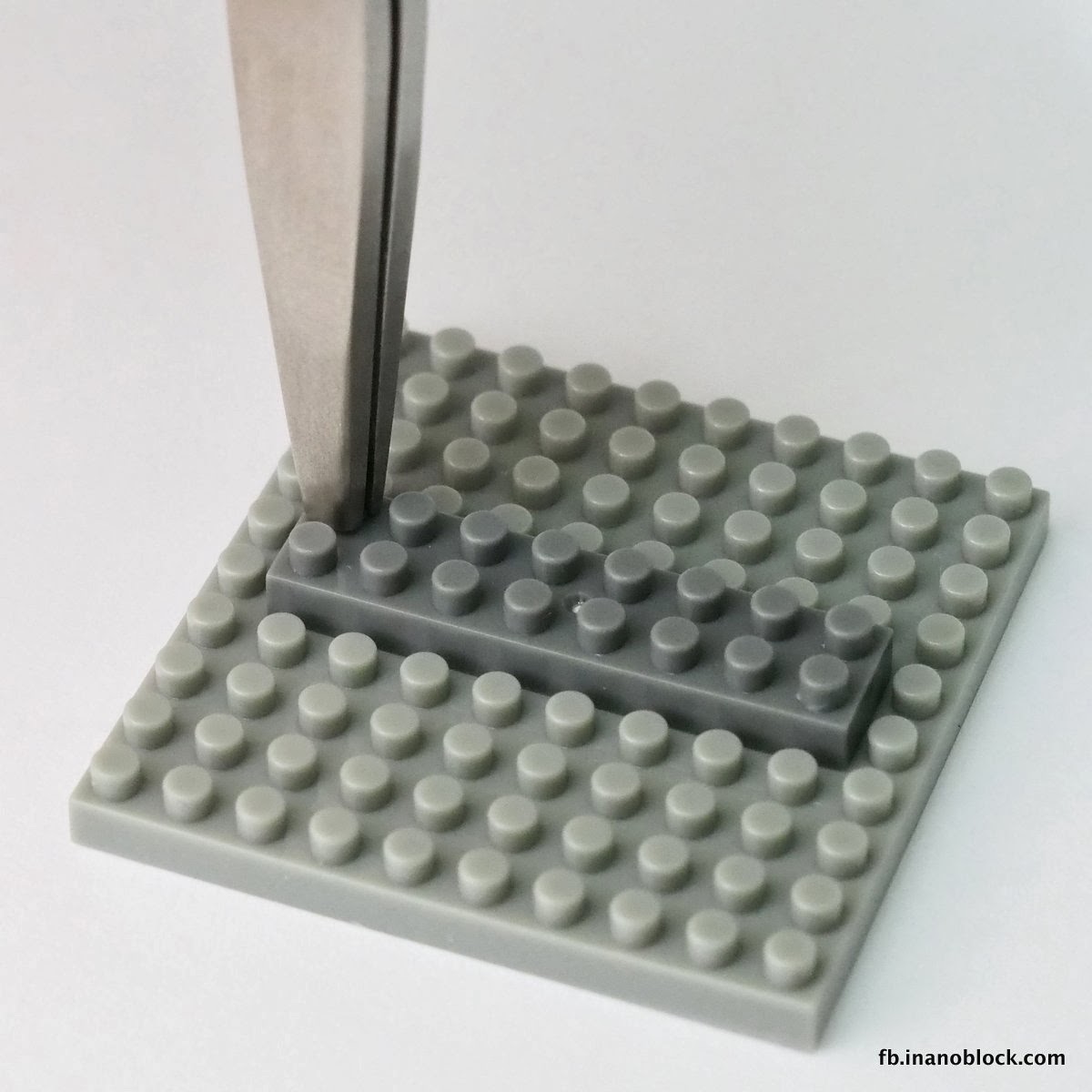
Japanese retailer descriptions carrying Kawada’s wording go further and say the jaws are ground to match the stud so grip improves and parts are less likely to be scratched than with ordinary tweezers. Seen up close, that’s exactly what the tips do — each jaw carries a shallow square recess, so a stud drops into it instead of squirting sideways under pressure.
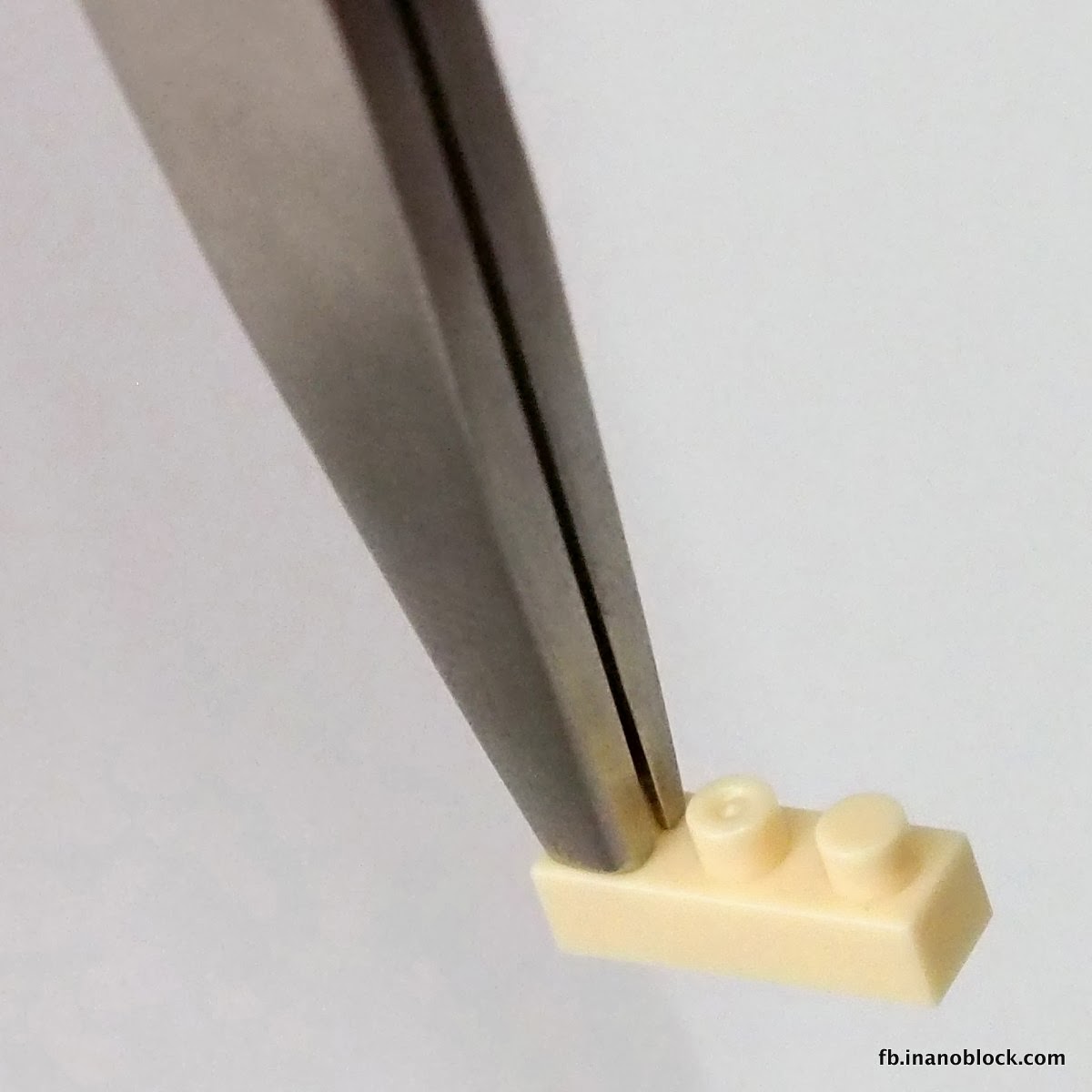
The practical split follows from the geometry. A notch grips a stud. A flat jaw grips a flat surface. If most of your building involves standard studded bricks and the occasional extraction of a misplaced one, the notch earns its keep. If you work with a lot of smooth tiles and thin plates, the flat pair has an advantage the notched pair does not — on a studless part, the recess has nothing to seat on and you’re gripping edge-to-edge anyway.
One caveat on the item numbers. The NB-019 has a live page in Kawada’s current catalog. A catalog lookup for NB-052 returns no product page, and the German specialist retailer that stocks it as “Pinzette 2 (NB-052)” lists it as unavailable. The NB-052 designation itself comes from community catalog work rather than a current manufacturer page, so treat the number as a strong community identification rather than a confirmed current SKU. The product is clearly still in production under the “simplified ver.” name, since it appears at US retail.
What Kawada actually publishes
Only the NB-019 has a full published specification sheet, so the two columns below are deliberately uneven. That gap is itself worth knowing about before you order.
| Detail | nanoblock Tweezers (NB-019) | Simple Tip Tweezers / “simplified ver.” |
|---|---|---|
| Tip shape | Notched to seat over a stud | Flat |
| Tool length | 120 mm (Kawada: 14 × 120 × 9 mm) | Roughly 120 mm, from a retail listing stating about 4.7 in. |
| Package size | 50 × 180 × 12 mm | Not published |
| Release date (Japan) | August 30, 2013 | Not published |
| Japanese price | ¥1,430 including tax | Not published by Kawada |
| Age marking | 12 and up (Japan) | 14 and up on the US listing |
| Material | Described as stainless steel in Kawada-sourced retail copy; a 2014 firsthand review describes solid steel | Unclear — see the note below |
Figures for the NB-019 come from Kawada’s own Japanese catalog page, with the dimensions and release date repeated on the English version. The price and release date are Japanese specifications and don’t translate to US retail.
The material line deserves a flag. Kawada does not state a material on either catalog page. Japanese retail copy for the NB-019 says stainless steel, and in Christopher Tan’s 2014 review on iNanoblock he weighed his pair at 25.3 g and described it as solid steel. Meanwhile the Target listing for the simplified version records the material as plastic, which contradicts every other description of these tools, including a 2025 video review that calls them metal tweezers. Retail listings routinely carry auto-filled attributes, so the plastic entry is most likely a data error rather than a product variant. Since neither Kawada nor its North American distributor publishes a material spec for the simplified pair, we can’t resolve it outright.
Do you need tweezers at all?
Kawada’s instruction sheets recommend the tools. A 2022 hands-on build of the Pokémon Lugia set at The Outer Haven notes that the manual points builders toward the pad and tweezers, sold separately, and Reddit posters have quoted their manuals referencing NB-019 and NB-020 by number. A recommendation printed in a manual is not the same as a requirement, though, and the community record on this is unusually clear.
In the r/nanoblock thread started by a builder who found £15 steep for tweezers, one commenter reported completing more than 40 sets, some running into the thousands of pieces, without ever using a pair, and described them as definitely not essential. In a separate beginner thread, another builder said they’d assembled more than 30 models without the accompanying tools, and a third who had worked through roughly half the Pokémon line managed without either the tweezers or the pad. These are individual accounts rather than a survey, but they point the same direction.
The same threads are just as clear about who the tool helps. Builders mentioned weaker grip strength, fingers that aren’t especially dexterous, and the specific job of separating two bricks that went together wrong. Tan reached a similar conclusion from the opposite direction: he preferred his fingers for general building because it was faster, and reserved the tweezers for cramped spots his fingers couldn’t reach and for taking models apart, which he said the tool made noticeably easier.
Buy the NB-019 if you disassemble models often, you’re working on a large set where a misplaced brick is likely, your hands tire or hurt during long sessions, or you’d rather not use a fingernail as a prying tool. Skip it if you’re buying a single small Collection-series set, you’re comfortable handling 4 × 4 mm parts, or a precision pair already lives in your desk drawer. Nothing in the documented builder experience suggests a beginner needs it to finish their first model.
How builders actually use them
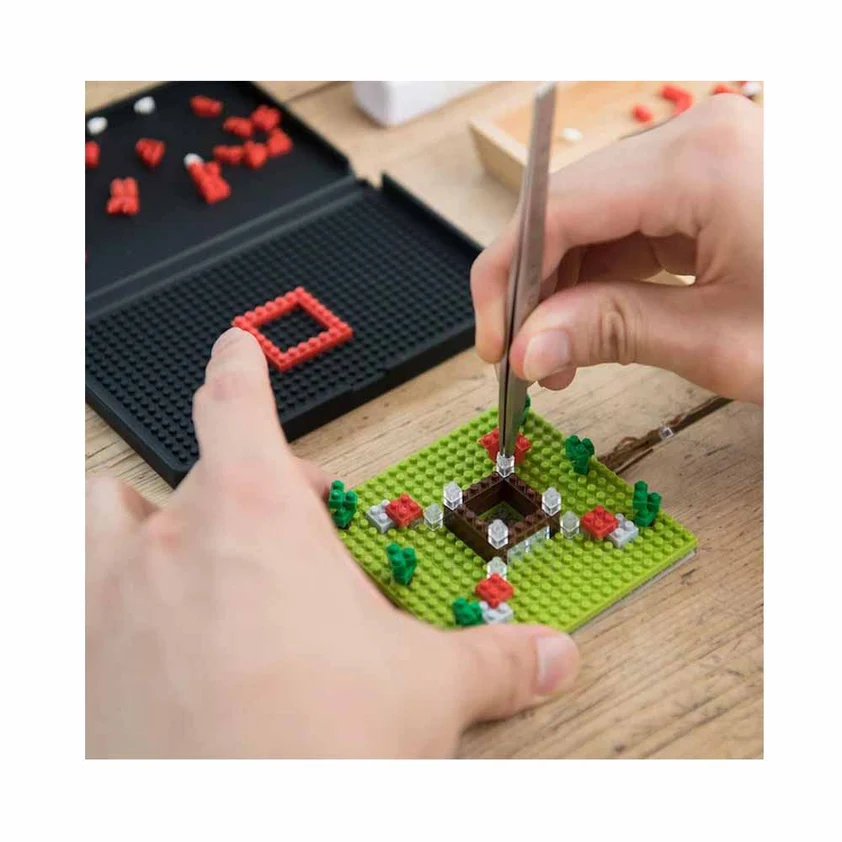
The technique that comes up most often is for taking bricks apart rather than putting them together. Tan describes gripping the brick’s end stud and pulling straight up, which he found especially effective on larger bricks. A builder in the stuck-brick thread described holding the lower brick with their fingers while gently wiggling and pulling the upper brick with the tweezers, then finishing the separation with a fingernail once a gap opened. Another said they simply use two pairs at once. There is no official procedure for any of this, so treat these as approaches that worked for individual builders.
The video below is a short unboxing of the metal tweezers alongside the PAD mini, and it’s worth watching for one reason in particular: it reads out the care instructions printed on the packaging, which don’t appear on the catalog pages.
“Nanoblock PAD Mini and Metal Tweezers (Review)” by A Unboxing, published June 2025.
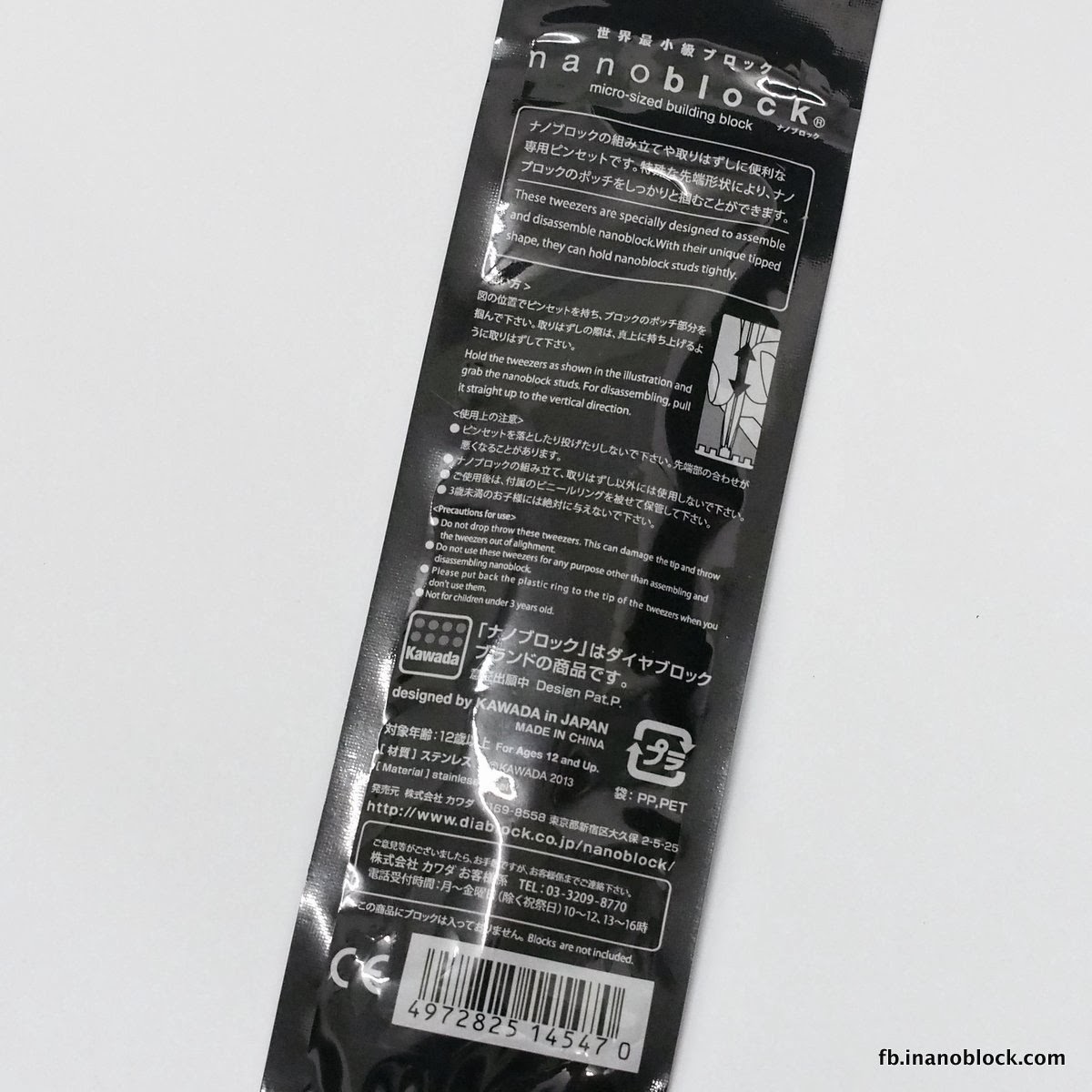
In that review, the presenter notes that the packaging warns against dropping or throwing the tweezers because the tip can shift out of alignment, and against using them for anything other than assembling and disassembling nanoblock. That first warning is the practically important one. A notch only works while both jaws still meet correctly, and a bent tip turns a purpose-built tool into an ordinary pair of tweezers. The presenter also describes the tip as dull rather than sharp, which fits the design intent — a fine point would slip off a stud rather than seat on it.
On the question of whether the grip damages bricks, the only documented test is Tan’s: he deliberately applied excessive force to a brick and reported that it still looked fine afterward. One test on one brick is thin evidence, so it’s reassuring rather than conclusive.
Matching the problem to the tool
Tweezers solve some nanoblock frustrations and are the wrong answer to others. The table sorts the complaints that recur in community threads against what builders reported using, so you can see whether your particular problem is actually a tweezers problem.
| Problem | What builders reported using | Is this a tweezers job? |
|---|---|---|
| Two bricks fused together after a mistake | Hold the lower brick, wiggle and lift the upper one by an end stud; a fingernail to finish. One builder mentioned an X-acto blade, with an explicit caution about damaging brick edges | Yes — the notched NB-019 is the strongest case for buying one |
| Fingertips sore after a long session | Tweezers, or flexible thimbles suggested in a thread about protecting fingers | Partly — thimbles were raised as a cheaper fix for handling, not extraction |
| A brick from an earlier step has come loose deep inside the model | A thin rod or needle to nudge the part back into place without dismantling the surrounding layers | No — a rod reaches where jaws can’t open |
| Smooth tiles and flat plates slipping out of the jaws | The flat Simple Tip pair, described in the r/nanoblock thread as a nice addition for studless tiles | Yes, but the flat pair rather than the notched one |
| The first layer keeps shifting or lifting as you build upward | The nanoblock PAD or PAD mini; one builder suggested tape laid sticky-side up as a substitute | No — this is what the pad exists for |
| Small parts scattering across the table | A tray, or a silicone baking or crafting mat | No — a workspace fix, not a tool fix |
Two of the six most common complaints aren’t tweezers problems at all, which is worth knowing before you spend money on the wrong accessory.
Cheap alternatives, and when they’re enough
Generic precision tweezers cover most of what builders actually do with the official pair. In the r/nanoblock discussion, one commenter said any brand of needle-nosed or precision tweezers would be useful and mentioned using an inexpensive set bought online for a few dollars. Commenters in the beginner thread agreed that an ordinary pair already on hand would do the job, though several of them specifically recommended tracking down the standard notched model rather than the simplified one if the choice was available.
That preference makes sense on the geometry. A generic fine-tipped tweezer can pick up a brick and place it perfectly well. What it can’t do is seat securely on a stud to pull a brick straight out of a finished layer, which is exactly the task the notch was cut for. If picking and placing is your whole use case, a five-dollar pair is a reasonable choice. If extraction is why you’re shopping, the notch is the feature you’re paying for.
A few improvised methods circulate in the same threads and deserve a word of caution. Builders have mentioned knives, craft blades and even teeth for separating stubborn bricks — one poster who described the teeth method acknowledged it wasn’t the classiest approach. Blades near thin ABS parts risk gouging edges, and the person who suggested the X-acto blade said as much. If a brick is stuck badly enough that you’re reaching for a blade, a proper pair of tweezers is the cheaper repair.
Why the pad may matter more than the tweezers
This is the recommendation most buying pages miss. In the r/nanoblock thread about tool costs, a commenter judged the pad or mini pad more useful than the tweezers, and the reasoning is structural: nanoblock models are assembled layer by layer, so a loose first layer undermines everything built on top of it.
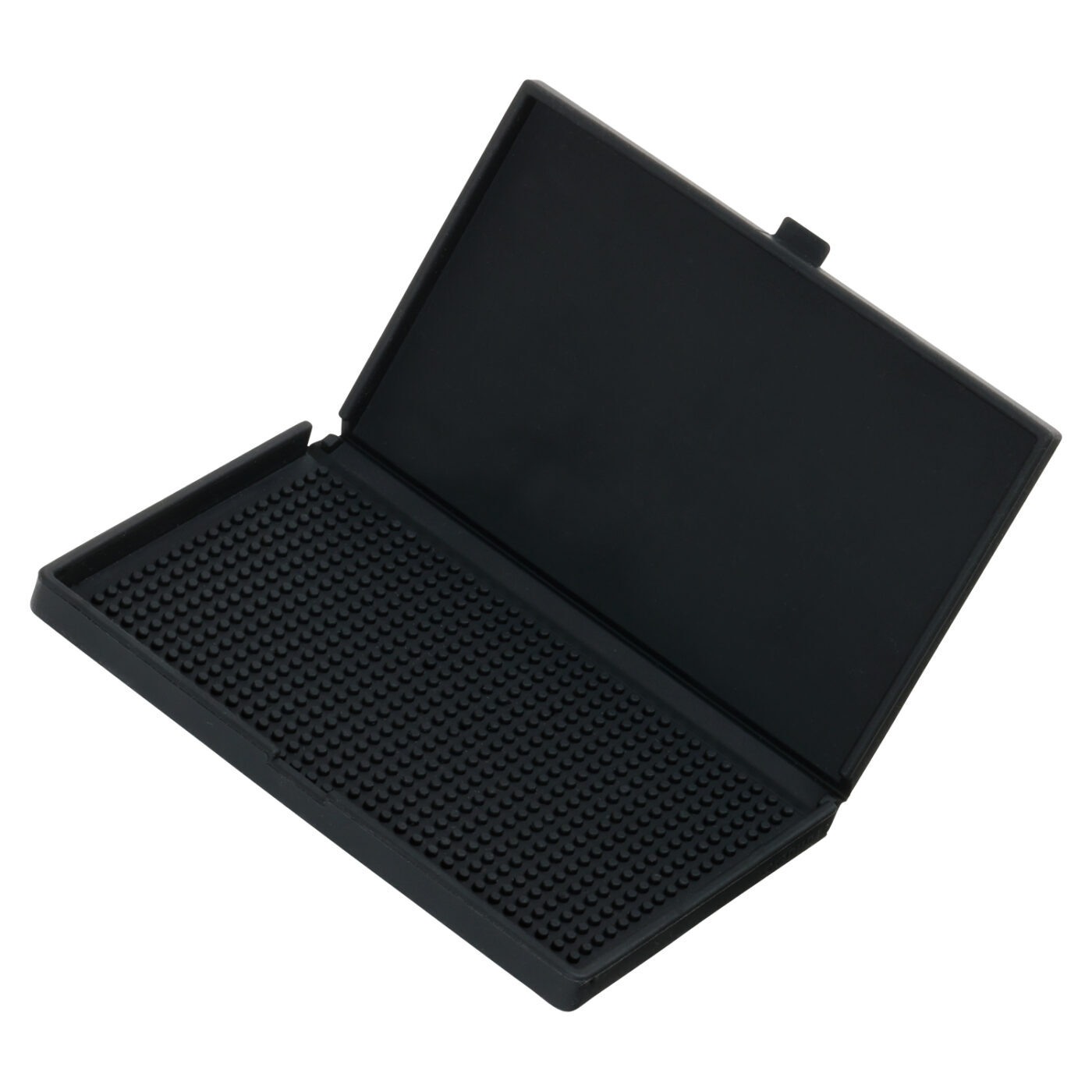
Kawada describes the nanoblock PAD (NB-020) as a silicone pad whose bumps stop blocks shifting and stop the assembly collapsing while you build the second layer and above. It also doubles as a tray for parts tipped out of the bag. Opened, it measures 142 × 10 × 190 mm. The newer PAD mini (NB-053), released in January 2023 at ¥825 including tax, is 80 × 80 × 2 mm and about a quarter the size of the full pad, with bumps at the same pitch.
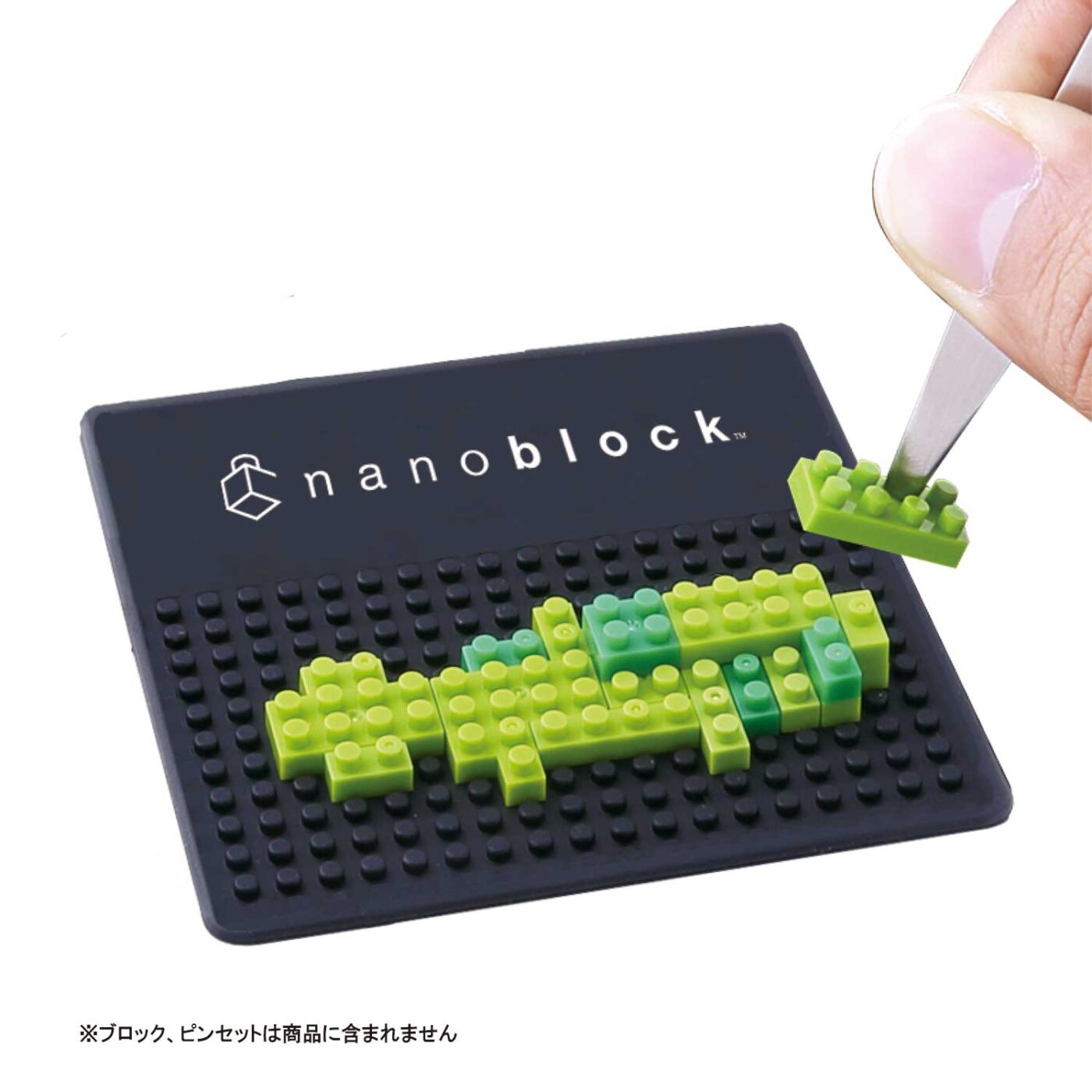
Firsthand accounts of the pad are more positive than accounts of the tweezers. The Outer Haven reviewer hesitated over the pad, expecting to have to pry finished sections off it, and found the flexible rubber held segments firmly while still releasing them easily. Their conclusion was that Lugia’s small footprint meant the pad wasn’t strictly necessary, but that it would matter more on wide builds like Lapras or the city sets. That maps neatly onto a purchase order: if you build large sets, the pad first; if you build small sets and take them apart often, the tweezers first.
Finding a pair in the United States
Nanoblock has been distributed in the US and Canada by Bandai Namco Toys & Collectibles America, operating as Bluefin, since the partnership with Kawada began on April 1, 2021. In practice that means the accessories reach US shelves through mainstream retail rather than through a Kawada storefront, and stock is erratic.
The simplified tweezers are the easier of the two to find domestically. Walmart has carried the item as “Nanoblock Tweezers Simplified Version Accessory,” and Target lists the same product at a $14.99 list price through a third-party seller, showing out of stock at the time this guide was prepared. The notched NB-019 appears mostly through Japanese and European specialist retailers, which is why beginners searching a US site so often find only the simplified pair while their manual names NB-019. Kawada’s own online store sells the NB-019 within Japan only.
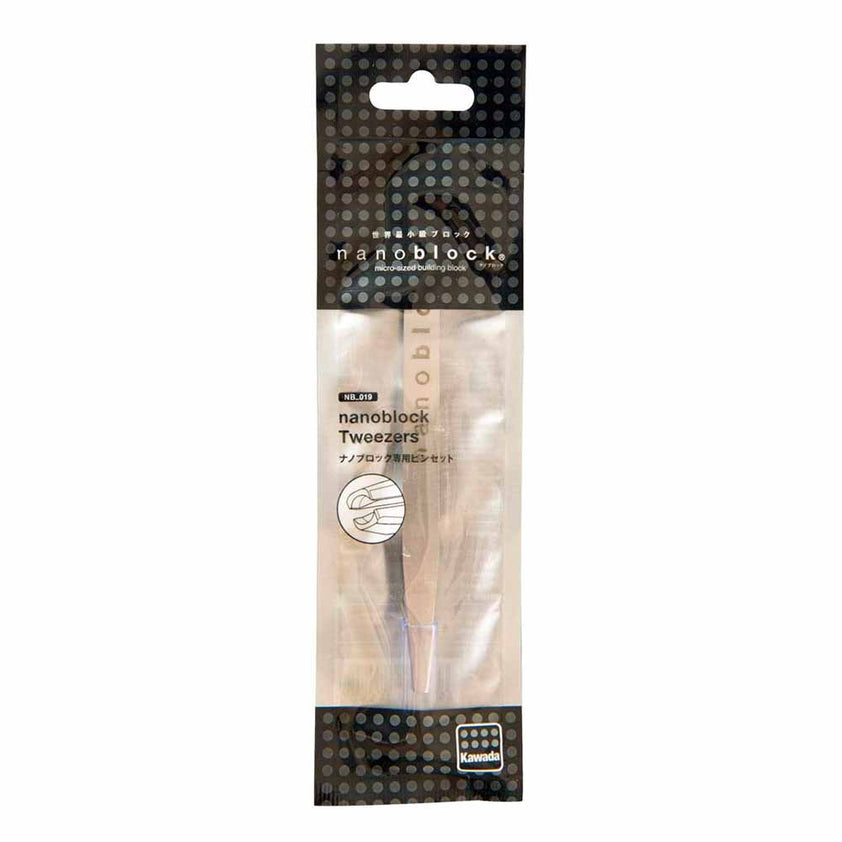
Two things follow. If you want the notched model in the US, expect to order from a Japan-based hobby retailer or watch marketplace listings, and confirm the item number on the packaging rather than relying on the product title. And if the price of an imported pair plus shipping starts to look unreasonable for a tool you’ll use occasionally, the community’s own advice applies — a precision pair from a general retailer covers ordinary picking and placing.
Prices and stock referenced here change frequently. Check the retailer before ordering.
What the official pages don’t explain
Kawada’s catalog handles this accessory thinly, and knowing where the silence falls saves time.
No material is stated for either pair, despite steel and stainless steel appearing throughout retail and review descriptions. There is no published comparison between the notched and flat versions anywhere on Kawada’s site, so builders are left inferring the difference from a two-line feature blurb. The care warnings about dropping the tool and keeping it to nanoblock use appear on the package insert rather than online, which means you only learn about the alignment risk after purchase.
And while manuals recommend NB-019 and NB-020 by number, nothing explains that the recommendation is a comfort suggestion rather than a requirement — the reassurance that a first set can be completed bare-handed comes entirely from other builders.
Questions builders keep asking
Are nanoblock tweezers worth it?
For frequent disassembly, large sets, or hands that tire easily, the notched NB-019 does something no generic tool matches. For occasional building of small sets, the documented experience of builders who have finished dozens of models without any tweezers suggests you can wait.
What’s the difference between NB-019 and the simplified version?
The NB-019 tip is notched to seat over a brick’s stud. The simplified or Simple Tip pair has flat jaws, which a builder in the r/nanoblock discussion recommended for studless tiles. Kawada publishes full specifications only for the NB-019.
Can I use regular tweezers on nanoblock?
Builders in the community threads say yes for picking up and placing parts, recommending needle-nosed or precision tweezers. The one job where the official notch has a real edge is pulling a brick out of a completed layer.
What separates two nanoblock bricks that are stuck together?
The most commonly described method is holding the lower brick with your fingers and wiggling the upper brick free by one of its end studs, finishing with a fingernail once a gap appears. Blades come up in the same threads, always with a warning about damaging brick edges.
Do I need the pad as well?
Not strictly. Kawada designed it to keep lower layers from shifting, and one community member rated it more useful than the tweezers. The reviewer who built Lugia found the pad genuinely helpful but said its value rises with the model’s footprint.
Are the tweezers included with any sets?
Kawada’s PAD mini page states plainly that blocks and tweezers are not included, and the Lugia build notes that the manual recommends both as separate purchases. Kawada has offered starter bundles pairing a small set with a mini pad and tweezers, but those have been Japan-only.
Where to go from here
Before ordering anything, open the manual for the set on your table and check which task is actually slowing you down. If you’re fighting bricks that went in wrong, the notched NB-019 is the purchase to chase, item number confirmed on the package. If your first layer keeps sliding around, the PAD mini is the cheaper and more direct fix. And if you simply want more control over 4 × 4 mm parts, try the precision tweezers already in your desk for one build before spending anything — several experienced builders never needed more than that.