
The short answer: choose the compact Nanoblock Pad Mini NB-053 if you mainly build small character or animal sets and want a simple way to steady the foundation. Choose the larger NB-020 if you expect to build regularly, want more room around the model and would use its separate parts-tray area. Neither pad is required to assemble a Nanoblock set.
Both are flexible silicone building aids made by Kawada. Their raised studs hold loose foundation pieces in position while the next layer connects them. That addresses one of the more frustrating parts of a Nanoblock build: aligning a first layer that is not yet strong enough to hold itself together.
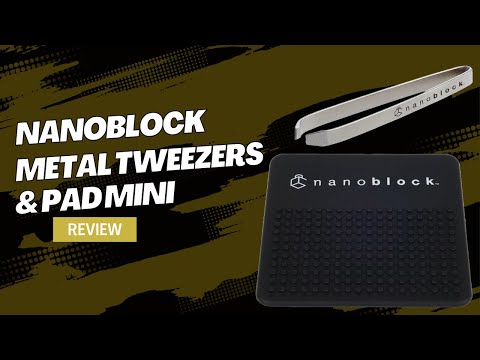
Watch the original video on YouTube.
In this guide:
The quick choice
The right pad depends less on experience level than on the footprint of the models you plan to build. A first-time builder working on compact Pokémon, animal or character models may get everything needed from the 80 × 80 mm NB-053. The Mini is easy to place on a crowded desk and easy to store between builds.
NB-020 makes more sense when the pad will become a permanent part of your building setup. Kawada designed it with a studded construction area and a second section that can act as a tray for loose pieces. Its full open size is 142 × 190 mm, so it requires more desk space but provides a more self-contained workspace.
| Choose | When it fits | Main compromise |
|---|---|---|
| NB-053 Pad Mini | Small models, limited desk space, travel or a cautious first purchase | No separate sorting tray and less room for broad foundations |
| NB-020 Pad | Frequent building, a dedicated workspace or builders who want a tray beside the model | Larger stored and open footprint; U.S. availability may require more searching |
| No pad | Occasional builds, builders comfortable making foundation subassemblies or models that do not fit comfortably on either pad | The first loose layers may take more patience to align |
NB-020 vs. NB-053
Kawada lists both products as Nanoblock accessories rather than building sets. They have no piece count, difficulty rating or completed model. Their job is narrower: to support a model’s lower layers temporarily during assembly.
| Specification | Nanoblock Pad | Nanoblock Pad Mini |
|---|---|---|
| Item number | NB-020 | NB-053 |
| Japanese release date | March 28, 2014 | January 21, 2023 |
| Product size | 142 × 190 × 10 mm open; 142 × 90 × 10 mm closed | 80 × 80 × 2 mm |
| Approximate inch conversion | 5.59 × 7.48 × 0.39 inches open | 3.15 × 3.15 × 0.08 inches |
| Workspace design | Studded building section plus a tray section | Compact studded pad |
| Japanese target age | 12 and older | 12 and older |
| Blocks or tweezers included | No blocks or tools are presented as part of the accessory | No; Kawada explicitly excludes them |
The dimensions above come from Kawada’s official catalog pages for the NB-020 and NB-053. Kawada labels the dates and target ages as Japanese specifications, so U.S. packaging may carry different warnings or age guidance.
Official NB-020 photographs
Kawada’s product gallery shows the pad fully open, its studded building section, adjoining tray, packaging and folded storage configuration.
Official NB-053 photographs
Kawada’s product gallery shows the square Pad Mini, its packaging, studded surface and a demonstration model positioned on the pad.
Official photographs remain on Kawada’s website because the manufacturer prohibits unauthorized copying of its text and images.
What “one-quarter the size” means
Kawada describes NB-053 as approximately one-quarter the size of NB-020 while noting that the raised studs remain the same size. That statement is accurate when the products’ complete open footprints are compared: 80 × 80 mm is about 24% of 142 × 190 mm.
There is an important catch. The full NB-020 footprint includes both its studded building section and the adjoining tray section. Kawada does not publish the exact usable dimensions or stud count of the building section alone. It therefore does not follow that NB-053 provides exactly one-quarter of NB-020’s usable studded building area.
This distinction matters when choosing between them. NB-020’s practical advantage is not simply “four times more room for a model.” It is the combination of a broader accessory, a dedicated place for loose pieces and more flexibility in where a small foundation can be positioned.
What the pad actually does
Nanoblock models are commonly assembled layer by layer. Before the second layer bridges the first, the initial pieces can slide apart when touched. The pad’s studs temporarily anchor those loose pieces so that the next layer can be pressed into place without chasing the foundation across the table.
That is why builders tend to notice the greatest benefit at the beginning of a model or subassembly. In a documented comparison of both pads, Shy Gal describes laying out the base layer on the studded surface, adding the second layer and then continuing on the pad only while it remains convenient. That is one experienced builder’s workflow, not an official requirement.
Shy Gal’s Building Blog includes original photos of NB-020 and NB-053 together, their relative sizes and a close-up of the raised studs.
View the photos and firsthand review.
The review photographs are linked rather than copied because the publisher does not provide an explicit third-party image-reuse license.
A pad cannot correct a misplaced brick, interpret the instruction diagram or make a fragile design structurally stronger. It also does not guarantee that every foundation will fit. Broad, irregular or offset layouts may overhang the NB-053, and some assemblies may be easier to make as separate sections away from the pad.
Practical distinction: a silicone pad is a temporary assembly aid, not the hard display base supplied with some Nanoblock sets.
Who benefits most?
- Beginners whose first-layer pieces move while they try to attach the next layer.
- Builders with limited finger dexterity who need the foundation to remain stationary.
- Collectors who assemble many compact models and want a repeatable starting surface.
- Anyone who regularly loses loose pieces across a smooth desk, especially if choosing NB-020 for its tray area.
Who may prefer another approach?
If you build only occasionally, buying a pad is optional. Builders in r/nanoblock beginner discussions describe completing sets without one by connecting parts of the first two layers as smaller sections and then joining those sections together. These are individual techniques rather than manufacturer instructions, but they show that the accessory solves a convenience problem rather than a strict compatibility requirement.
A large architectural model may also outgrow the useful working area of either accessory. In that case, follow the model’s official diagrams and use an appropriately sized, level workspace rather than forcing an overhanging foundation onto a small pad.
How to use it
This guide is a practical companion to the manufacturer’s official instructions. It does not replace the official diagrams.
- Prepare the parts away from the studded area. Sort the bricks required for the opening diagram by color and shape. On NB-020, the adjoining tray can contain loose pieces; with NB-053, a separate shallow tray prevents pieces from mixing with the foundation.
- Lay out the foundation exactly as shown. Seat each bottom-layer brick on the pad’s studs, preserving every gap and offset in the set’s diagram. The pad holds positions; it cannot tell you whether those positions are correct.
- Add the connecting layer. Press straight down with controlled pressure. A correctly positioned second layer usually begins tying the independent foundation pieces into one assembly.
- Recheck the footprint early. Compare the completed lower layers with the diagram before continuing upward. Finding a one-stud error now is easier than dismantling a nearly finished model.
- Move off the pad when it stops helping. Once the lower assembly is stable, support it near the base and remove it carefully. Continue in your hands or on the table if that provides better access to the sides.
When removing the assembly, avoid pulling from a narrow head, limb or decorative section. Supporting the lower layers and easing the flexible pad away reduces the load placed on the model. This is cautious editorial handling advice; Kawada’s catalog pages do not provide a detailed removal procedure.
Common problems
| Problem | Likely cause | Practical response |
|---|---|---|
| The first layer still moves | A brick is resting between studs, is not fully seated or the diagram includes an offset that has been misread. | Pause before adding more layers. Compare the foundation with the diagram and reseat each piece vertically. |
| The model extends beyond NB-053 | The foundation is wider than the Mini’s 80 × 80 mm surface or is positioned too close to an edge. | Recenter it if the diagram allows. Otherwise, use NB-020 or assemble stable sections away from the pad. |
| A brick will not line up with the pad | The model may use an offset orientation that has been interpreted incorrectly, or that section may not sit conveniently on the pad. | Return to the set’s diagram. Do not alter the model simply to make it conform to the pad. |
| The lower assembly separates during removal | It was lifted by an upper detail, or too few connecting layers had been completed. | Support the base, ease the flexible pad away gradually and remove the assembly only after its lower layers hold together. |
| The larger pad feels unnecessary | The builder mainly makes small models and does not use the integrated tray. | NB-053 is probably the more efficient choice. The larger accessory earns its space through repeated use and organization, not because every model needs its full footprint. |
| Loose bricks collect on the studded area | NB-053 has no separate tray, or unsorted pieces were poured directly onto the working surface. | Move unused parts to a shallow container so that they cannot interfere with foundation placement. |
A closer look at NB-053
In the video below, A Unboxing opens the Pad Mini and shows its physical size, flexible texture and packaging. The creator says he had not yet assembled a Nanoblock model, so the footage is useful as a physical overview rather than evidence of long-term performance or a controlled comparison with NB-020.
Video and thumbnail credit: A Unboxing on YouTube. The metal tweezers shown in the video are a separate accessory and are not included with the Pad Mini.
Buying and identification
Search by item number, not only by the phrase “Nanoblock pad.” NB-020 identifies the folding pad with the additional tray area; NB-053 identifies the square Pad Mini. Retailers sometimes shorten or rearrange the product names, making the model number the clearest way to distinguish them.
- NB-020: Nanoblock Pad, with a Japanese release date of March 28, 2014.
- NB-053: Nanoblock Pad Mini, with a Japanese release date of January 21, 2023.
- Manufacturer: Kawada Co., Ltd.
- North American regional contact: Bandai Namco Toys & Collectibles America, as listed by Kawada.
Compare the official packaging and product photographs:
Use the printed model number as the main identifier. Packaging language, distributor labels and retailer photography may vary by market.
Both products still have official Kawada catalog pages, but a live catalog page does not prove that a particular U.S. retailer has current stock. Check the seller, shipping origin and return terms before ordering. Imported NB-020 listings may also cost more to deliver than their initial product price suggests.
For identification, compare the listing and package against the model number, dimensions and Kawada branding shown on the official page. Distributor labels and packaging designs can change, so one sticker should not be treated as the only authenticity test.
Frequently asked questions
Do you need a Nanoblock Pad?
No. It steadies the first loose layers, but builders can complete sets without it. If foundation alignment is the part you find frustrating, the pad addresses that specific problem more directly than tweezers do.
Is the Pad Mini big enough for a first Nanoblock set?
It is a sensible starting choice for compact models whose foundations fit within its 80 × 80 mm surface. Kawada does not publish a complete compatibility list, so examine the opening diagrams or base footprint of unusually wide sets before assuming they will fit.
Does NB-053 use smaller studs?
No. Kawada states that the studs are the same size as those on NB-020. The accessory is smaller because it provides a more compact surface, not because it uses a reduced Nanoblock connection scale.
Can the silicone pad replace a display base?
It is better treated as a temporary building aid. If a set includes a hard display plate, follow the set’s diagrams for transferring or attaching the finished model. The pad’s flexibility is useful during assembly but is not the same as a rigid display foundation.
Are tweezers included?
Kawada explicitly states that NB-053 includes one Pad Mini and does not include blocks or tweezers. Check an NB-020 seller’s itemized contents as well rather than assuming that tools pictured beside the pad are part of the package.
Is NB-020 four times larger than NB-053?
The Mini occupies approximately one-quarter of NB-020’s complete open footprint. However, NB-020’s stated footprint includes its non-studded tray area. Kawada does not publish enough information to conclude that NB-020 offers exactly four times as much studded building space.
Which pad should a beginner buy?
Start with NB-053 when you are testing the hobby, working in a small space or building compact models. Choose NB-020 when you already expect to build repeatedly and value the adjoining sorting tray. If you are still uncertain, look at the foundation diagram of your next set: its width is more relevant than the set’s total piece count.
Your next step is simple: note the model number of the set you plan to build, inspect its opening foundation diagram and compare that footprint with the 80 × 80 mm Pad Mini. If it appears cramped—or if you want loose pieces contained beside the model—search for NB-020 instead.
NanoblockUS.com is an independent fan and informational resource dedicated to Nanoblock builders in the United States and beyond. We are not affiliated with Kawada Co., Ltd., the manufacturer of Nanoblock.. Our team is made up of hobbyists, collectors, and detail-obsessed builders who want to help you get the most out of these remarkable micro building sets.