There is no single Nanoblock Demon Slayer set. Kawada has released the license in several waves since 2020, and most of the popular characters exist twice — sometimes three times — under different NBCC numbers, with different piece counts and different difficulty ratings. A Tanjiro from the first wave is catalogued as NBCC_088 with 190 pieces and a 2/5 rating on the community Nanoblocks Wiki. The Tanjiro currently on US shelves is a later release, subtitled “Sun Breathing,” rated 3/5 by Aniplex Online and built around clear effect bricks. Same character, different model. The rest of this guide sorts every release by number, flags where the published specs disagree, and explains which version is worth your money.
In this guide:
- Three waves, same faces
- Every set by NBCC number
- Which version should you buy?
- A 2/5 and a 3/5 are not the same afternoon
- What “2.4 inches” looks like on a shelf
- A first-wave figure on camera
- Where these turn up in the US
- When a bag is short a piece
- If you want something bigger
- Questions we see most often
Three waves, same faces
The naming system is the thing that trips people up, so it is worth getting straight before you look at a single price.
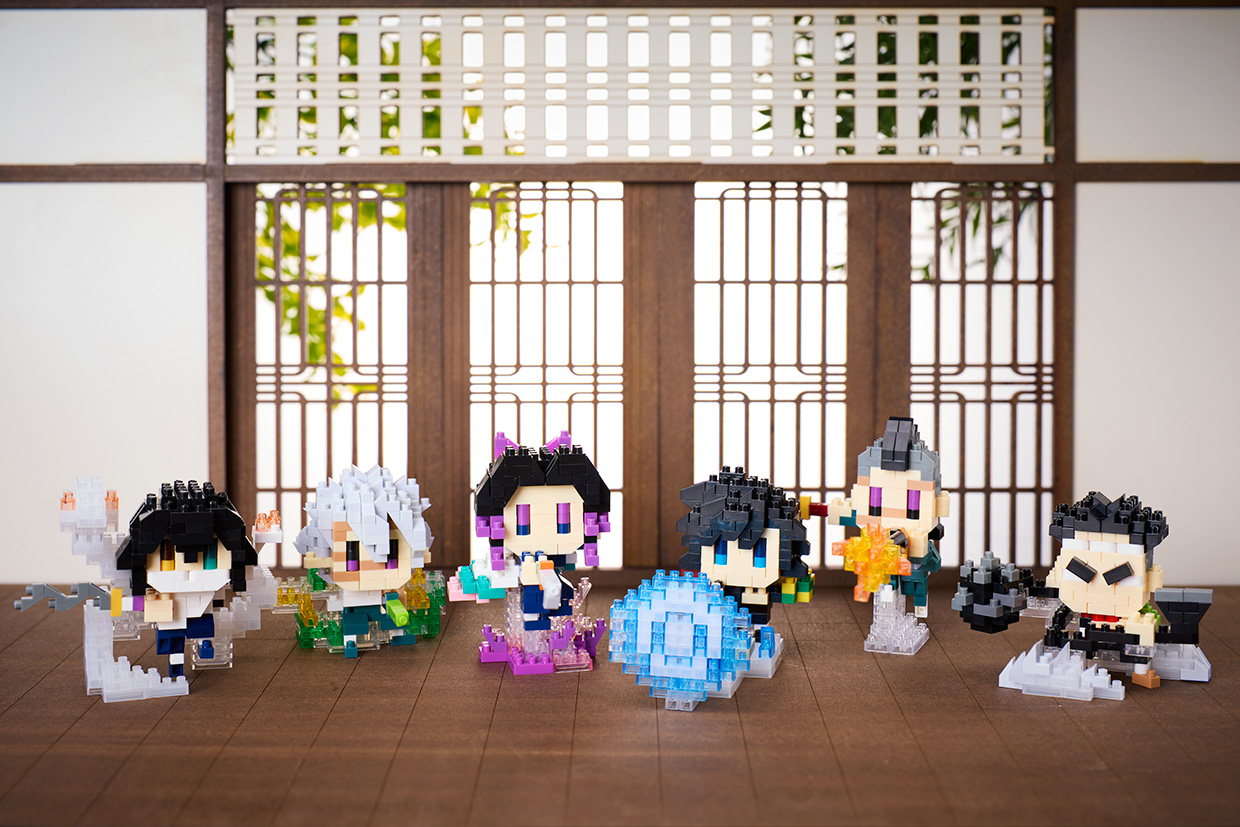
The first Demon Slayer figures arrived as NBCC_088 through NBCC_094 — Tanjiro, Nezuko, Zenitsu, Inosuke, Giyu, Shinobu and Rengoku. The wiki records all seven at 180 to 210 pieces and a difficulty of 2/5. A second group, NBCC_110 through NBCC_116, added the remaining Hashira plus Kanao at similar sizes and the same 2/5 rating. These are plain standing figures. No effect parts, no display base, nothing in clear plastic.
Then the line restarted. Aniplex Online’s product page for the anime series presents eight characters — Tanjiro, Nezuko, Zenitsu, Inosuke, Rengoku, Tengen, Muichiro and Mitsuri — all at 3/5 difficulty and ¥1,800 plus tax, with a late-October 2023 delivery window. Those correspond to NBCC_164 to NBCC_171, and in English-language retail they carry a breathing style in the product name: Tanjiro Kamado (Sun Breathing), Nezuko Kamado (Blood Demon Art), Zenitsu Agatsuma (Thunder Breathing), and so on. A further group followed, which distributor listings number NBCC-239 through NBCC-244: Giyu, Shinobu, Genya, Gyomei, Sanemi and Obanai.
So if you see two Nezukos at two prices, you are not looking at a reprint or a fake. You are looking at a 2020 design and a 2023-onward redesign that happen to share a character.
Every set by NBCC number
Piece counts and difficulty for the first two waves come from the Nanoblocks Wiki, which is community-maintained and has gaps. Treat them as a reliable guide to relative size rather than as manufacturer figures.
| Character | Number | Pieces | Difficulty |
|---|---|---|---|
| Tanjiro Kamado | NBCC_088 | 190 | 2/5 |
| Nezuko Kamado | NBCC_089 | 190 | 2/5 |
| Zenitsu Agatsuma | NBCC_090 | 200 | 2/5 |
| Inosuke Hashibira | NBCC_091 | 180 | 2/5 |
| Giyu Tomioka | NBCC_092 | 200 | 2/5 |
| Shinobu Kocho | NBCC_093 | 210 | 2/5 |
| Kyojuro Rengoku | NBCC_094 | 200 | 2/5 |
| Character | Number | Pieces | Difficulty |
|---|---|---|---|
| Tengen Uzui | NBCC_110 | 180 | 2/5 |
| Muichiro Tokito | NBCC_111 | 170 | 2/5 |
| Mitsuri Kanroji | NBCC_112 | 200 | 2/5 |
| Obanai Iguro | NBCC_113 | 190 | 2/5 |
| Sanemi Shinazugawa | NBCC_114 | 210 | 2/5 |
| Gyomei Himejima | NBCC_115 | 200 | 2/5 |
| Kanao Tsuyuri | NBCC_116 | 180 | 2/5 |
Two caveats on that second table. Barnes & Noble lists Gyomei Himejima at 210 pieces and about 2.6 inches and Kanao Tsuyuri at 200 pieces and about 2.4 inches — ten and twenty pieces above the wiki figures. Neither source publishes its methodology, and Kawada’s own English catalog does not currently list Demon Slayer among its character filters, so there is no easy manufacturer page to settle it. A ten-piece gap changes nothing about the build; we mention it so you know the numbers floating around retail listings are not all copied from one authoritative sheet.
For the third group, Aniplex publishes finished dimensions rather than piece counts. These are the official figures, in millimeters, width × height × depth:
| Character (English retail name) | Number | Finished size (mm) | Retailer piece count |
|---|---|---|---|
| Tanjiro Kamado (Sun Breathing) | NBCC_164 | 68 × 63 × 80 | 230 |
| Nezuko Kamado (Blood Demon Art) | NBCC_165 | 56 × 72 × 47 | not published |
| Zenitsu Agatsuma (Thunder Breathing) | NBCC_166 | 64 × 56 × 48 | 250 |
| Inosuke Hashibira (Beast Breathing) | NBCC_167 | 100 × 72 × 65 | not published |
| Kyojuro Rengoku (Flame Breathing) | NBCC_168 | 72 × 70 × 75 | 310 |
| Tengen Uzui (Sound Breathing) | NBCC_169 | 75 × 58 × 45 | not published |
| Muichiro Tokito (Mist Breathing) | NBCC_170 | 60 × 59 × 68 | 240 |
| Mitsuri Kanroji (Love Breathing) | NBCC_171 | 55 × 65 × 58 | 200+ |
Piece counts in that last column come from retailers, not Kawada: 250 for Zenitsu from Small Forge, 240 for Muichiro from Amazon’s listing, and 310 for Rengoku from Breezy Beach Co. Rengoku at 310 pieces is the largest count we could verify anywhere in the line, which fits a design carrying a flame effect.
The newest group is the one most likely to be sitting in a US warehouse right now. Piece counts and heights below are from PopMarket, cross-checked against Entertainment Earth, which agrees on Genya’s 180 pieces and on roughly the same heights.
| Character | Number | Pieces | Height |
|---|---|---|---|
| Giyu Tomioka (Water Breathing) | NBCC-239 | 240 | ~2.36 in |
| Shinobu Kocho (Insect Breathing) | NBCC-240 | 230 | ~2.75 in |
| Genya Shinazugawa | NBCC-241 | 180 | ~2.95 in |
| Gyomei Himejima (Stone Breathing) | NBCC-242 | 230 | ~2.16 in |
| Sanemi Shinazugawa (Wind Breathing) | NBCC-243 | 240 | ~2.36 in |
| Obanai Iguro (Snake Breathing) | NBCC-244 | 240 | ~2.55 in |
Genya is the interesting entry there: the lowest piece count in the group but the tallest figure, and the only one without a breathing style in its name. That tracks with the character, who fights without a breathing technique, and it suggests a simpler, more vertical build than his six shelf-mates.
Which version should you buy?
Three different goals point to three different answers.
If this is your first nanoblock set, an older 2/5 release is the gentler introduction, and you can often find one cheap. Shy Gal’s Building Blog, which documents individual nanoblock builds, describes several of the earlier Demon Slayer figures — Muichiro Tokito and Sanemi Shinazugawa among them — as splitting neatly into a head and a body. Two contained sub-builds of under about 110 pieces each is a manageable first evening with 4 mm bricks. That is one builder’s account of her own builds rather than a manufacturer statement, but it is consistent across her reviews of the line.
If you want a display piece, buy from the newer numbers and don’t overthink it. The clear breathing-effect parts are what make these read as Demon Slayer from across a room, and the official 3/5 rating is the price of that detail. Rengoku (NBCC_168) is the showpiece of the line on the numbers available: the highest verified piece count and a 72 × 70 × 75 mm footprint, meaning it takes up roughly as much desk space front-to-back as it does side-to-side.
If you are assembling the full Hashira, the newest group is the one to prioritize, because the earlier releases have been out of production long enough that availability is now down to whatever individual retailers still hold. Mixing waves on one shelf does look slightly inconsistent — some figures will have effect bases and some will not — so it is worth deciding early which generation your display is going to follow.
Who should skip these entirely: anyone shopping for a child. Every listing we checked carries a choking-hazard warning and a floor of 12 or 15 years, including Target’s Rengoku listing. Amazon’s Muichiro page is internally inconsistent, showing 15+ in one field and 12+ in another. Either way, a 4 mm brick is not a kid’s toy, and anyone who wants a buildable Demon Slayer figure for a younger fan should look at a larger-format brick line.
A 2/5 and a 3/5 are not the same afternoon

Kawada’s difficulty scale runs from 1 to 5. The jump from 2 to 3 across the generations matters more than the modest increase in piece count suggests, because the added pieces are concentrated in the parts that are hardest to handle: small clear elements forming water, flame, lightning or mist, often cantilevered off the figure rather than stacked underneath it. Based on the published specifications and the structure visible in official photography, the effect assemblies are where a newer build is most likely to come apart in your hands and need redoing.
We have not found reliable evidence for an average build time in this line, and we are not going to invent one. A single creator’s recorded session tells you the scale of a project, not a benchmark. If you want a planning figure, treat a 200-piece 2/5 figure as an evening and a 240-to-310-piece 3/5 figure as something you may want to split over two sittings — and adjust after your first one.
Two practical notes that apply regardless of which version you pick. Work on a tray or a rimmed surface, because a dropped clear 1×1 on a light carpet is effectively gone. And keep the bags you empty: Kawada’s packaging is your only sorting system out of the box, and once several similar dark-navy uniform pieces are loose together, sorting them back out costs more time than the pouring saved.
What “2.4 inches” looks like on a shelf
These are small. Most finished figures land between roughly 2 and 3 inches tall, and Aniplex’s millimeter figures confirm that width often exceeds height — Inosuke’s newer version is listed at 100 mm wide against 72 mm tall, which is close to four inches across. If you are planning a row of six Hashira, budget by width, not height.
Published heights do not always line up, and we would rather say so than average them. Small Forge lists the newer Zenitsu at about 3.14 inches, which is roughly 80 mm, while Aniplex gives that character’s finished size as 56 mm tall. Neither source explains its measuring basis, and the most plausible explanation is that one figure includes a base or raised effect part and the other does not. Until someone measures a retail sample, take retailer heights as approximate.
A first-wave figure on camera
If you are trying to work out whether the older releases still appeal to you, the most useful thing is to see a finished one. In A Nerd Named Mark’s showcase of NBCC_088, the original Tanjiro is turned on camera from several angles; the creator states the set’s 190 pieces and 2/5 difficulty in the video description, matching the wiki entry. It is a showcase rather than a timed tutorial, so it will not tell you how long a build takes, but it does show how much character a 190-piece figure at this scale can carry — and how plain the figure looks without the clear effect parts that later releases added.
Video by A Nerd Named Mark. Embedded with credit; this site does not own the footage.
Where these turn up in the US
US retail list price for a single figure has been sitting around $17.00 according to PopMarket, and street prices routinely fall below it. BoxLunch has been discounting the newest six to about $13.52, Target has carried the Character Collection kits in the high teens, and Amazon’s listings move between roughly $13 and $19 depending on the character. Entertainment Earth is the most reliable place to confirm which characters are currently catalogued, since it lists them by full official name including breathing style. Premium Bandai USA has also offered a Demon Slayer Character Collection bundle at $120 — worth checking against six singles at a discount before you commit, and worth confirming exactly which characters are inside, because the shop index does not itemize them.
Prices and stock in this category change week to week. Check the retailer page before you act on any figure quoted here.
On authenticity: micro-brick figures in anime licenses are widely copied, and the box is your best check. Amazon’s listing for the Mist Breathing Muichiro notes a Bandai Namco warning label on the packaging as evidence of an officially licensed Kawada product. Look for the nanoblock logo, a Kawada or Bandai Namco licensing mark, an NBCC product code, and a copyright line crediting Koyoharu Gotoge, Shueisha, Aniplex and ufotable. A listing that shows only a rendered image of the figure and no box, or that omits the NBCC number entirely, deserves more scrutiny than a few dollars of savings is worth.
When a bag is short a piece
This is the weakest spot in the whole ownership experience, and it is fair to be blunt about it. There is no established equivalent of BrickLink for nanoblock parts. In a r/nanoblock thread, a builder whose Amazon-bought set arrived without four clear L-shaped pieces and two 1×3 clear slanted pieces asked exactly this question; the only reply came from someone with the same problem and no solution. Two people in one thread is not a survey, but it does show the gap is real — and clear pieces, the ones most likely to be missed, are also the ones the newer Demon Slayer releases depend on most.
The practical sequence, in the order most likely to actually work: start with the retailer, since a replacement or refund within the return window is faster than any parts hunt. Kawada’s own nanoblock contact page lists regional and export addresses for overseas inquiries, which is the right route from the US — note that Kawada’s Japanese domestic phone support explicitly does not cover overseas inquiries. Failing both, a second copy of a cheap older set is sometimes a cheaper source of common colored parts than chasing singles.
Before you assume a shortage, count again against the diagram. Nanoblock instructions work in dense layer-by-layer diagrams, and a piece that is one stud out of position early will make a later layer look as though parts are missing when the real problem is three layers down.
If you want something bigger
These figures top out around 310 pieces, which puts a ceiling on how much of an evening any one of them can fill. Builders who want the same brick system at real scale should look outside the Character Collection to nanoblock’s larger licensed and architectural sets, where piece counts run into the thousands and difficulty ratings reach 5/5. Collectors who specifically want more anime characters at this size will find the same Character Collection format applied to Jujutsu Kaisen, My Hero Academia, Naruto and Yu-Gi-Oh!, all of which share the NBCC numbering and the same handling quirks described above.
Questions we see most often
Is there one official “nanoblock Demon Slayer set”?
No. Every release is a single character sold separately. The closest thing to a set is a multi-figure bundle, such as the Demon Slayer Character Collection bundle listed by Premium Bandai USA.
Why does the same character have two different prices?
Usually because they are two different models. An older 2/5 figure with no effect parts and a newer 3/5 figure with clear breathing effects can share a character name while differing in NBCC number, piece count and size. Check the number and whether the product name includes a breathing style.
Do these come with instructions?
Yes — retail listings describe step-by-step instructions in the box. Link out to the official manual for your specific NBCC number rather than following a guide written for a different one; the waves are not interchangeable.
Are the earlier figures discontinued?
We could not confirm a formal discontinuation from Kawada, and Demon Slayer does not currently appear in the character filters on Kawada’s English catalog. What is observable is that the earlier numbers now appear mainly through individual retailers and resellers, while the newest six are the ones in active US distribution. Treat older releases as limited by whatever stock remains.
Which one is the best value?
On published specifications, Rengoku’s newer release gives you the most pieces for a price that sits alongside the rest of the line. If your priority is simply getting a recognizable figure on a shelf for as little as possible, a discounted older 2/5 release does that for less.
Your next step
Before you add anything to a cart, find the NBCC number on the listing and match it against the tables above. That one check tells you the generation, the approximate piece count, whether clear effect parts are included and which difficulty rating applies — and it is the single fastest way to avoid paying newer-release money for an older figure, or buying a second copy of a character you already own in a different version.